
These are carbon copies of the testimony Paul gave to an unknown entity around 1957. The pages were found among the family papers. Below the images is the translation.
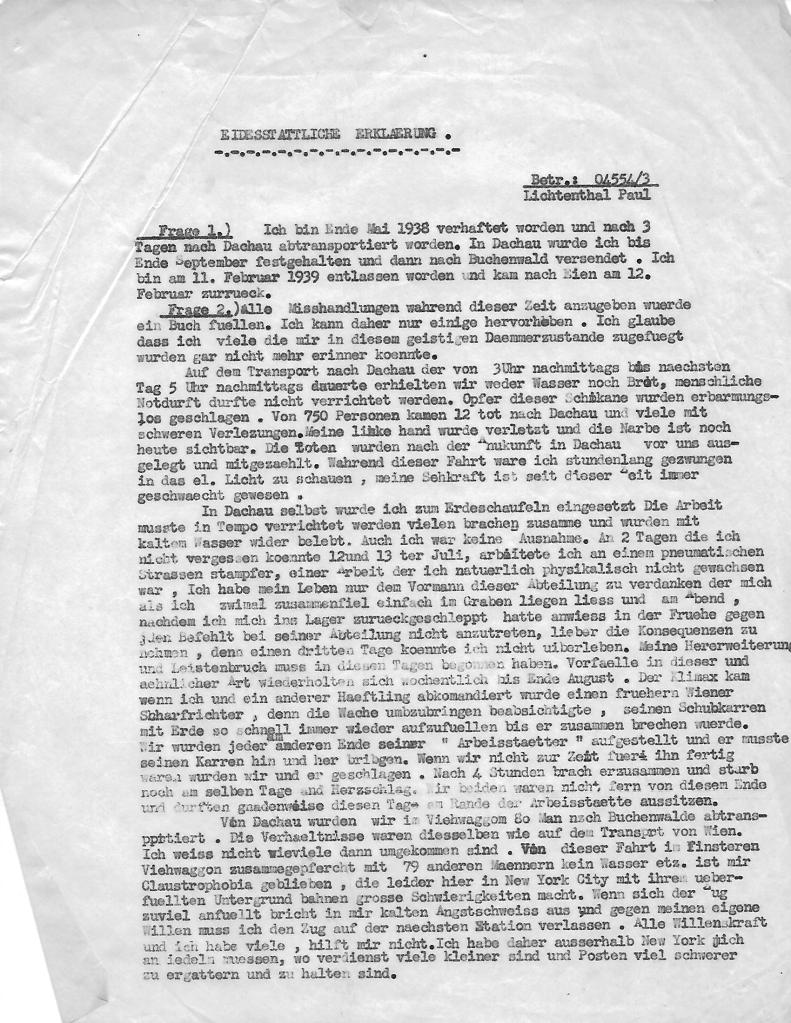
Paul’s sworn testimony -page 1
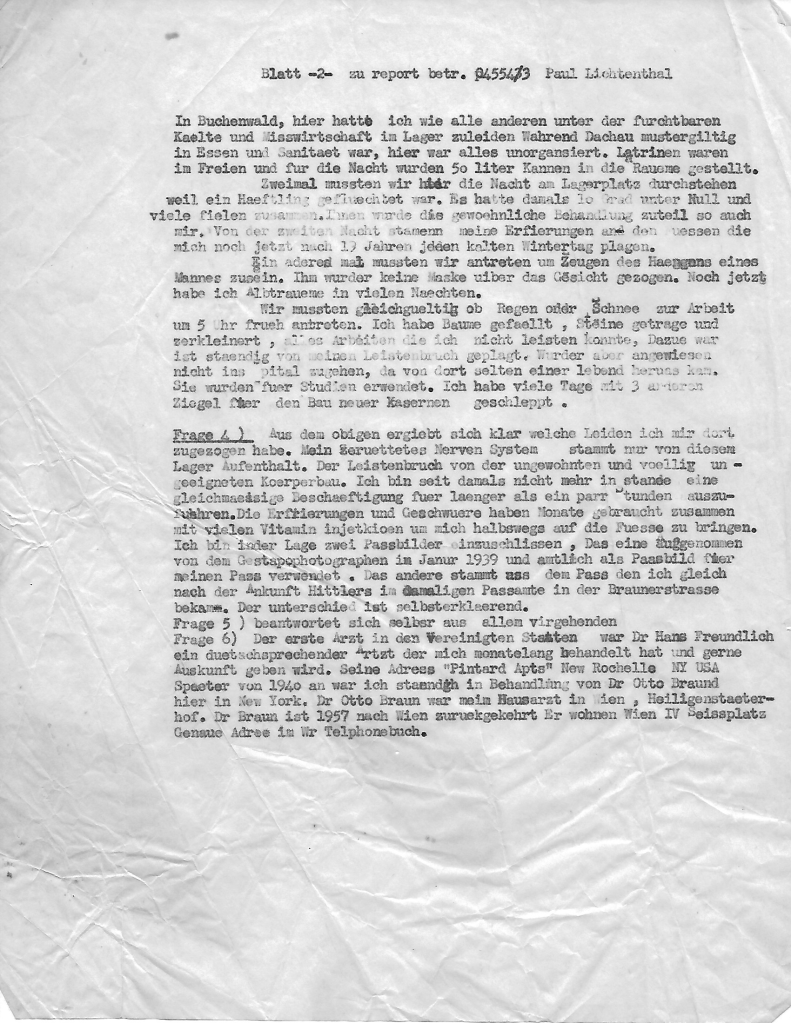
Paul’s sworn testimony -page 2
Translation of Sworn Testimony – Paul Lichtenthal BETR.,: 04554/3
Question 1
I was arrested at the end of May 1938 and after 3 days removed to Dachau. I was there until the end of September and then sent to Buchenwald. On February 11, 1939, I was dismissed and returned to Vienna on February 12.
Question 2
Telling about all the abuse during this time would fill a book. I believe that many abuses during that time of mental obfuscation cannot be retrieved. On the trip to Dachau from 3:00 p.m. until 5:00 the next afternoon, we did not receive any water nor bread. Nor were we allowed other human necessities.
Victims of this chicanery were struck pitiless. Out of 750 persons, 12 died on the way to Dachau. My left hand was hurt and the scar is still visible today. The dead ones were laid out before us and counted. I was forced to look into the electric light for hours. My sight has always been weakened since this time.
In Dachau, I had to break the earth with shovels. The work had to be done very fast and many collapsed. Cold water was used to revive them. I was not an exception. On 2 days which I could not forget, the 12th and 13th of July, I worked on a soil compactor. I twice simply collapsed in the ditch. I was left to lie there and, in the evening, after I had dragged myself back to camp, I felt I could not survive. I owe my life to the foreman of the work detail who advised me against orders not to show up the next day.
Incidents of this and similar kind repeated themselves to the end of August. The guards would intentionally fill up the wheelbarrow again as soon as we emptied. My heart disease goes back to these days. These incidents were scarring. The climax came when another prisoner and I were ordered to fill wheelbarrows with earth so quickly that we would collapse. We were set up at ends of the “work station” and had to truck it back and forth. If we did not finish at the right time we were struck. After 4 hours, my fellow prisoner collapsed and died the same day.
We were sent by railroad cattle car from Dachau to Buchenwald. Conditions were the same as on the transport from Vienna. I don’t know how many died then. I traveled in the dark railroad cattle car with 79 other men and no water. Claustrophobia overcame me. This caused great difficulty here in New York with the overcrowded underground [subway]. If the train fills too much, I break into a cold sweat and must leave the train at the next station. Even all my willpower does not help. Therefore, I must work outside of New York City, where earnings are much less and jobs are harder to find and hold.
Page Two
In Buchenwald, I, like all the others had to suffer with the terrible cold weather and mismanagement in the camp. While Dachau was well-organized regarding food and sanitation, Buchenwald was terribly disorganized. Latrines were in the open and for the night, 50 litre cans were placed into the rooms. Twice we had to spend the night in the open camp because a prisoner had fled. It was at that time, 10 degrees below zero and many collapsed. They received the usual treatment as I did as well. During the second night I suffered frostbite. It still plagues me today, after 19 years, when the weather turns cold. At one time, we were ordered to be witnesses to a hanging. The man had no mask and to this day I have nightmares. Regardless of whether it rains or snow, we were to start work at 5 o’clock. I felled stones, carried stones and small pieces, work I could not carry out. I spent many days with 3 other prisoners carrying bricks for the building of a new barracks. In addition, I was troubled constantly by my hernia. However, I was advised not to go to the hospital as few ever came out alive. The dead were used for studies.
Question 4 (there was no Question 3)
The aforementioned incidents show which suffering I endured. My destroyed nerves go back to this camp life. The hernia [was made worse] by the unaccustomed work and my totally unfit physique. Accordingly, I am no longer able to do the kind of work I did before, for more than a few hours. The frostbite and other problems took months to clear up.
I am able to include two passport pictures. One was taken by the Gestapo photographer in January 1939 and was officially used as my passport picture. The other I got in the former passport office on Brown Street office just after the arrival of Hitler. The difference is self-explanatory.
Question 5
“beantwortet sich selber aus allem virgehenden”: Seems to mean: answers himself from everything going on {unsure of what that means]
Question 6
The first physician in the United States who treated me was Dr. Hans Freundlich, who speaks German. He treated me for many months. I am certain he would gladly corroborate my testimony. [lists address of Dr. Freundlich in New Rochelle, NY] From 1940 on, I was treated by Dr. Otto Braun here in New York. Dr. Braun was my physician in Vienna. Dr. Braun returned to Vienna in 1957. [lists address of Dr. Braun in Vienna]
 nothingreallybadwillhappen.com